


If you own a business, most of what you read about taxes was written for W-2 employees. It doesn’t quite fit.
There’s real planning to be done for business owners, but very little of it lives inside our office alone. Your CPA prepares the return. Your attorney handles the entity choice and succession documents. A plan administrator runs the retirement plan itself. What we try to do is make sure those pieces are all pointing at the same set of goals: yours.
Here are three areas where that coordination matters most.

1. The right retirement plan
Business owners have real options here. A SEP-IRA, a solo 401(k), and, for the right situation, a defined-benefit plan can each shelter meaningful income beyond what a W-2 employee could ever set aside. Which one fits your business isn’t a question we try to answer alone; your CPA and a plan administrator handle the setup and the year-by-year mechanics.
Where we tend to add value is one step back from that. When we sit down with a business-owner client, one of the first questions we ask is whether the retirement plan they’ve chosen is still the right one for where the business is now — not just where it was five years ago. That’s often the conversation that leads to a call with the CPA, not the other way around.

2. How you pay yourself matters
For S-corp owners, the split between W-2 salary and shareholder distributions has real weight. Too much salary and you pay payroll tax you didn’t need to. Too little and you invite the kind of IRS conversation nobody wants.
The specific number that’s defensible for your role and industry is a conversation for you and your CPA. What we help with is what that decision does to the rest of your picture, how much room it leaves for retirement contributions, how it changes your Social Security calculation, how it interacts with your family’s cash-flow plan. The tax decision doesn’t sit by itself, even if it can look that way from inside the return.
3. State tax and the pass-through entity election
The SALT cap was $10,000 under the TCJA. Under the One Big Beautiful Bill Act, the cap now sits at $40,400 for 2026, indexed up 1% a year through 2029 before reverting to $10,000 in 2030. It also phases out for income above about $505,000.
For owners near or above that phaseout, many states, Mississippi included, offer a pass-through entity tax election worth taking a look at. The mechanics vary by state and the election has to be made on time. Your CPA is the right partner for the specifics. What we do is make sure the decision fits into the broader plan.
The role we actually play
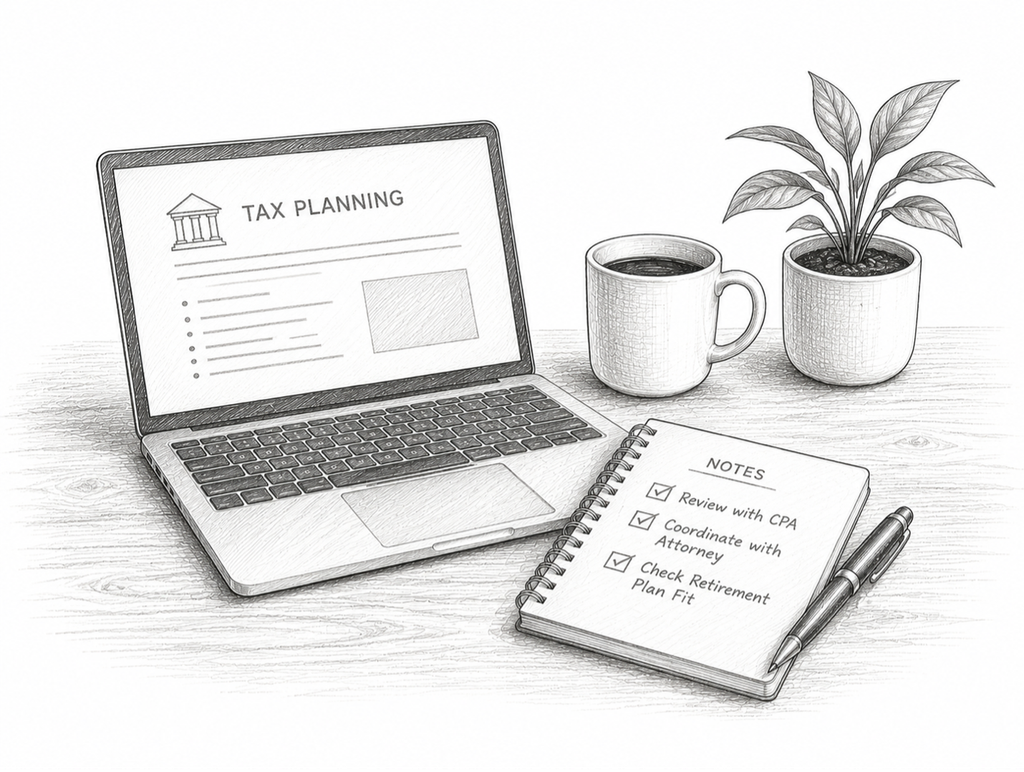
None of what’s above is our unique specialty. Your CPA knows your return line by line. Your attorney knows the entity documents. A plan administrator runs the retirement plan. Where we come in is coordination, helping the pieces line up so decisions made in one place don’t undo decisions made in another.
If you’d like to look at how the tax picture for your business fits into the rest of what you’re planning for, we’d love to sit down and walk through it with you. It is a privilege to serve you.
Bain Nickels, CFP®, CKA®

1 Comment
Comments are closed.